AP Automation for Xero: A Practical Guide for Hospitality and Tourism
Xero is very good at recording bills and paying them. What it doesn’t do on its own is everything that has to happen before a bill is ready to pay. Someone has to collect it, key it in, code it, check it against what was ordered, and get it approved by the right person.
In most small and mid-sized businesses, that work is still manual. Bills arrive in five different inboxes, get printed, sit on someone’s desk, and are entered into Xero the week before the payment run. That’s where errors, late fees, and duplicate payments come from.
Expense Claims and Reimbursement: A Guide for Hospitality and Tourism
A chef runs to the market because the fish delivery came up short. A villa manager buys a replacement pool pump fitting from the hardware store. A tour guide pays park entry fees for twelve guests in cash.
All of these are real business costs, paid by staff, often out of their own pockets. Each one has to be checked, approved, recorded, and paid back.
In hospitality and tourism this happens every day, across many people and many locations. Done badly, staff wait weeks to get their money back, receipts go missing, and finance spends month-end chasing paperwork. Done well, it’s quick for staff and gives finance the control it needs.
Innovative Accounting for Bali Tourism: What the Research Says
Tourism is the backbone of Bali’s economy. It is a main source of regional revenue and a major employer, and it supports a wide range of small businesses, from family warungs to tour operators and village tourism groups.
A 2025 paper by researchers at Warmadewa University in Denpasar asks a simple question: what role should accounting play in managing that industry well?
This article summarises what the paper found, and adds a practitioner’s view of what it means for tourism businesses in Bali today.
Support in Your Time Zone: Why It Matters for APAC Finance Teams
It’s month-end in Perth. A batch of supplier bills is stuck waiting for approval, an approver can’t see what they should, and payments are due tomorrow. You open a support ticket at 10am.
If your software vendor is based in California, it’s around 7pm the evening before. The team has gone home. You’ll probably get a reply overnight, and if that reply asks a follow-up question, you’re looking at another full day before anything is fixed.
2-Way vs 3-Way Matching: A Guide for Hospitality AP
Every accounts payable team has to answer one question before paying a supplier: should we pay this bill, and for this amount?
Invoice matching is how you answer it. Instead of trusting the invoice on its own, you compare it against other records of what was agreed and what actually happened. The two most common methods are 2-way and 3-way matching.
What is 2-way matching?
2-way matching compares two documents:
How Finance Teams Can Reduce Approval Bottlenecks
Most approval delays aren’t caused by bad people or bad intentions. They’re caused by the process. A bill sits for nine days, not because the approver disagreed with it, but because they didn’t know it was waiting, didn’t have enough information to decide, or were on leave.
The result is the same either way: late payments, unhappy suppliers, missed early-payment discounts, and a month-end close that drags.
Here’s how to fix it.
Scaling Without an ERP: How to Grow on Xero
At some point every growing company hears the same advice: “You’ve outgrown Xero. Time to move to an ERP.”
Sometimes that’s true. Often it isn’t. An ERP project usually means six to twelve months of implementation, consultants, data migration, and retraining a team that already knows Xero well. For a lot of businesses with two to ten entities, that’s a big cost to solve a handful of specific problems.
It’s worth being clear about what those problems actually are.
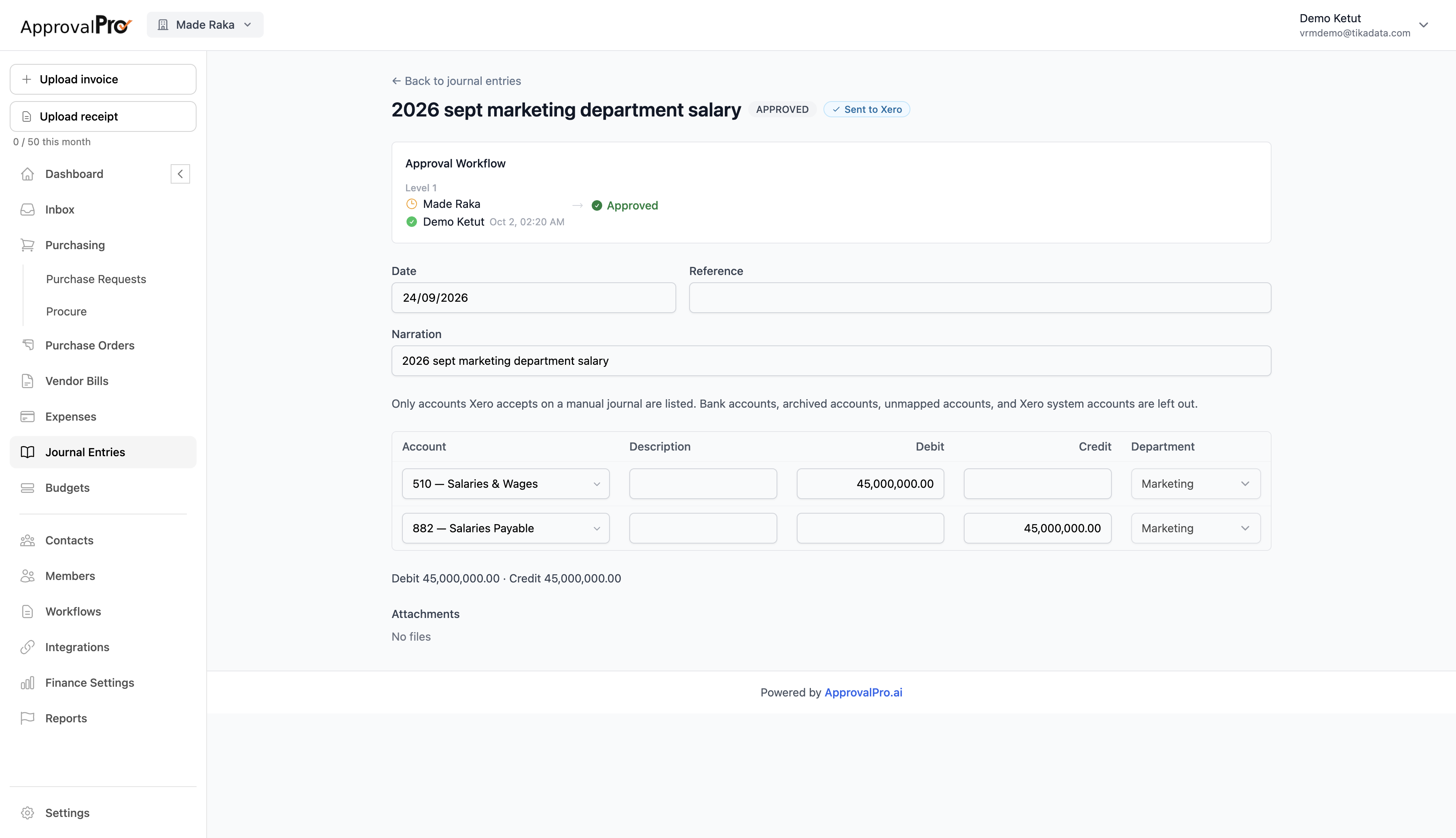
Manual Journal Entry Approval for Xero
Manual journals like payroll, accruals, and reclassifications can move big numbers in your books. In Xero, anyone with access can post one without a second pair of eyes. ApprovalPro.ai adds that review step with manual journal entry approval for Xero.
Draft it the way Xero expects
Auto-Capture Expenses in Your Xero Approval Workflow
Chasing receipts and keying expense claims into Xero wastes everyone’s time. ApprovalPro.ai captures expenses for you and makes sure they fit the budget before anyone hits approve.
Snap, upload, done
Upload a receipt or forward it by email. ApprovalPro.ai reads it and fills in the details — merchant, date, amount, and tax — so the claim is ready to route for approval in seconds.
Auto-Capture Vendor Invoices in Your Xero Approval Workflow
Typing invoice details into Xero by hand is slow and easy to get wrong. ApprovalPro.ai does it for you.
How it works
Upload a bill, or just forward it by email like you already do. ApprovalPro.ai reads the invoice and pulls out:
- Vendor name
- Invoice number
- Invoice date and due date
- Total amount
It’s ready to route for approval within seconds — no typing required.